Badrinath Dham
Kajal, 2 years ago, 7 min read, 269 Views
Overview
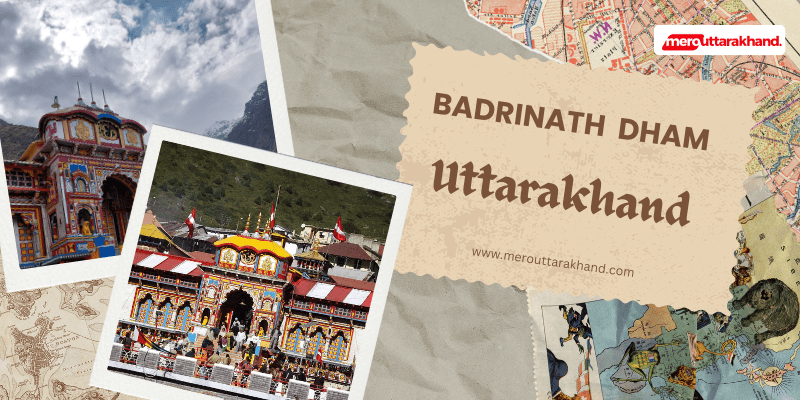
The lovely town of Badrinath brings divinity and environment together. The preeminent home of Lord Vishnu, located at a height of 3,133 meters in Uttarakhand’s Chamoli region, is one of India’s Char Dham pilgrimage’s holiest temples. Dwarka, Puri, and Rameswaram are among more Char Dham places.
Badrinath Dham is also on the Do Dham circuit in Uttarakhand. The sacred region of Vishnu, located between the Nar and Narayan hills, is part of the Chota Char Dham Yatra in Uttarakhand. Starting with Yamunotri, Gangotri, and Kedarnath, Badrinath is the final and most famed site on the Garhwal Himalaya pilgrimage trip. One can easily access Badrinath Dham through roads that cars can use and it is possible to walk comfortably all the way to go to Badrinath temple.
With a distance of about three kilometers from here is Mana which serves as a last stopover before you enter India/Tibet border. Neelkanth peak stands high above them all creating an immortal appeal on either pilgrim or visitor who comes across it.
Badrinath has numerous stories with every one serving to increase its greatness. The backdrop for spiritual connection here is provided by this land of many tales as well as white capped mountain peaks, Alaknanda River flowing gracefully and amazing scenic beauty.
Significance of Badrinath Dham
Badrinath is an important Hindu pilgrimage place in India’s state of Uttarakhand. Badrinath is located on the right bank of the Alaknanda River, at an elevation of 3,133 meters (10,279 feet) above sea level. Badrinath is one of the four major Char Dham pilgrimage Chota destinations in India, and it is regarded as one of the most sacred Hindu temples. A famous spot for pilgrimages has for some time been the sacred temple of Badrinath which is devoted to Lord Vishnu.
It was in the early eighteenth century that Maharaja Gulab Singh of Jammu and Kashmir constructed what is now termed the current temple. Every year a vast number of pilgrims both from within India itself and other parts of the world come to Badrinath Temple to ask for Lord Vishnu’s favor. According to mythology, the Vedic sage Narada founded the Badrinath Temple.
Another famous tale says that Lord Shiva and Goddess Parvati pondered here for several years. It is also claimed that Lord Vishnu arrived here in the shape of a human avatar (Badri). Badrinath’s significance stems from its religious value as a Hindu pilgrimage place. The temple is one of Lord Vishnu’s 108 Divya Desams, or sacred abodes. It is also one of the five largest Vaishnavite temples, known as Pancharama Kshetras.
The legend of the Badrinath Dham
Badrikaashram
Badrinath is one of the most legendary temples, with various fabled stories surrounding it. According to one mythology, Lord Vishnu conducted a thorough atonement at this location. He was completely unconscious of the harsh weather conditions while deep in meditation. To protect him from the blazing heat of the sun, his wife Goddess Lakshmi took the shape of a Badri tree and spread it over him. Lord Vishnu was gratified by her devotion and named the spot Badrikashram in her honor.
Lord Narayana’s desire for meditation in Badrinath Dham
Another mythology holds that Lord Shiva and Goddess Parvati were once performing tapasya in Badrinath. Lord Vishnu then appeared disguised as a young boy and disrupted them by wailing aloud. When Goddess Parvati inquired about his melancholy behavior, he said that he intended to meditate in Badrinath. Shiva and Parvati left Badrinath for Kedarnath after discovering Lord Narayan in disguise.
The Story of Nar and Narayana
Badrinath Dham is also associated with the story of Dharma’s two sons, Nar and Narayana, who aspired to establish a monastery and expand their religious base in the holy Himalayas. According to mythology, their search for a suitable location for their hermitage resulted in the chance discovery of the four Panch Badri sites, namely Dhyan Badri, Yog Badri, Bridha Badri, and Bhavishya Badri. Finally, they discovered a location with two remarkable cold and hot springs behind the river Alaknanda. They were pleased to locate this place and named it Badri Vishal, which is how Badrinath came to be.
Pandava’s rise to Swargarohini through Badrinath
It is also stated that the Pandavas from the sacred epic Mahabharata climbed via ‘Swargarohini, also known as the ascension to heaven, and Mana village, north of Badrinath, on their way to heaven.
The origin of the Alaknanda River
Last but not least, there is another amazing legendary tale about Badrinath. According to legend, the holiest and curse-relieving river Ganges approved Bhagiratha’s prayer to relieve humanity of the curse of pain and sin. While climbing to earth, the Ganges was so powerful that it could have submerged the entire planet in its floods. To save the planet from such dreadful repercussions, Lord Shiva bore her onto his tresses, and the Ganges was eventually divided into twelve holy rivers, one of which being the Alaknanda, which runs past the hallowed Badrinath Temple.
What to See At Badrinath Dham?
Badrinath Temple
According to ancient sources, this abode of Lord Vishnu is highly regarded, noting that “there are many spots of pilgrimage in the heaven, earth, and the world, but none has been equal to Badri, nor shall there be.” It stands proudly at 3,133 meters tall, with its rich history along the banks of the Alaknanda River. Adi Shankaracharya is supposed to have created the Badrinath shrine, which is considered the most prominent Vishnu temple. He discovered Lord Badri’s Saligram statue submerged in Alaknanda waters and put it in a cave near Tapt Kund.
In the 16th century, a Garhwal King ordered the construction of a temple to house the God statue. The current construction is the result of numerous renovations to the temple following avalanche and earthquake damage. Lord Vishnu can be worshipped as a black stone idol sitting in a meditative stance, surrounded by other gods’ idols such as Nar, Narayana, Narad, Ganesha, Garud, and Kuber. During the winter, the deity of Lord Badri is moved to Yogadhyan Badri in Pandukeshwar.
Tapt Kund
A natural thermal spring, thought to be infused with healing powers, is located just below the temple. A plunge in the holy and heated waters of the Kund is required before visiting the hallowed sanctuary of Badrinath. According to folklore, five rocks at Tapt Kund are Narad, Narsingh, Varah, Garur, and Markanday.
Brahma Kapal
It is a level platform located 100 meters north of the temple on the banks of the Alaknanda River. It is thought that performing propitiating rites for deceased family members will release them from the cycle of life and death.
Neelkanth Peak
Neelkanth Peak, often known as the ‘Queen of Garhwal’, stands at a massive height of 6,597 meters (approx.) and provides an excellent backdrop to the Badrinath shrine. Named after Lord Shiva, the snow-covered peak’s beauty is enhanced by receiving the first rays of the Sun at morning.
Mata Murti Mandar
It is located on the banks of the Alaknanda River, three kilometers from the Badrinath temple. Mata Murti shrine is considered to be the mother of Nara and Narayan, Lord Vishnu’s twin-brother avatars (incarnations). Mata Murti’s persistent pleas convinced Lord Vishnu to give birth from her womb. Every year, in September, pilgrims rush to attend the Mata Murti ka Mela.
Charanpaduka
Charanpaduka is a hard ascent of roughly 3 kilometers from Badrinath town, surrounded by stones and caverns. It is a rock said to have been imprinted with Lord Vishnu’s footprints as he descended from Vaikunth (his heavenly abode).
Sheshnetra
Between two seasonal lakes on the other bank of the Alaknanda River, there is a large rock that resembles Shesh Nag, Lord Vishnu’s fabled snake. The Sheshnetra bears a natural mark that resembles the eye of a Shesh Nag. The serpent, which lies 1.5 kilometers away from the temple, is thought to defend Badrinath’s sacred sanctuary.
Vasudhara Falls
A spectacular waterfall 122 meters high in the calm environs of the Himalayas can be accessed by driving 3 kilometers (up to Mana village) and walking the remaining 6 kilometers.
The best time to visit Badrinath Dham
Badrinath experiences a frigid and cold environment virtually all year. The best months to visit this location are from May to June and September to October. With the arrival of the monsoon season, Badrinath experiences heavy rain and a dip in temperature. The winters here are particularly chilly due to significant snowfall. Temperatures frequently drop below 0 degrees Celsius during the winter, making the climate uncomfortably frigid. As a result, the best time to visit this location is during the summer.
How Do I Get to Badrinath Dham?
Jolly Grant on Rishikesh Road in Dehradun is the closest airport to Gangotri. You can either get a bus or take a taxi from here.
Regular trains to Haridwar and Dehradun are available all year. From here, you can take a taxi or a bus.
Badrinath is easily accessible from major Uttarakhand locations via motor able roads.
Conclusion
The Badrinath Dham in Chamoli area, Uttarakhand, is one of the most sacred and revered places of Hindu pilgrimage in India. It is one among four shrines on the Char Dham Yatra along with Yamunotri, Gangotri and Kedarnath. And also one of the main Char Dham in India. It attracts hundreds of thousands of devotees who come from all over the country every year for sacred purposes.
To millions of Hindus across the globe, Badrinath Dham symbolizes faith, religion and spirituality. It is an obligatory point for pilgrims aspiring spiritual belief and divine mercy given its elaborate history, beautiful natural scenery and deep religious importance.
Related FAQs
What is the history of the Badrinath Dham, and who built it?
The Badrinath Temple does not have a historical record, yet it is mentioned in Vedic scriptures. The Badrinath Temple was thought to be a Buddhist Vihara until the ninth century, when Adi Shankaracharya visited and turned it into a Hindu temple.
According to another version of the narrative, Adi Shankarcharya created Badrinath as a Hindu pilgrimage place by putting the Badrinath idol he found in the River Alaknanda.
When Does the Badrinath Temple Open for Pilgrims?
The Badrinath Temple is open to pilgrims from May to November. On the day of Basant Panchami, the date for the opening of Badrinath’s doors to pilgrims is proclaimed.
Why is Badrinath Temple only open to tourists for six months?
There is a difficult winter for six months in Badrinath temple of Garhwal Himalayas due to its high altitude, from November through April. During the winter, heavy snowfall regularly blocks the road, making Badrinath impassable. As a result, the only practical time for the temple to be open is between May and October.
Why is Badrinath Dham so popular among travelers?
Apart from being a popular Hindu pilgrimage site, Badrinath Dham also catches the eyes of tourists for its easy accessibility and few attractions like Mana Village (the last inhabited village on the Indo-Tibet Border), the sacred Alaknanda River, scenic landscape, a few trekking trails, and proximity to attractions such as Valley of Flowers and Hemkund Sahib.
How are the accommodations in and around Badrinath Dham?
The accommodations are pretty good. There are all types of hotels in Badrinath- right from the expensive ones to the cheapest ones while in Joshimath they have 3 star accommodations only. If you go to Pipalkoti, there two options when it comes to accommodation; either 2 star hotels or 3.5 stars ones.

Kajal - Content Editor
Welcome to our blog! As the editor, my mission is to provide you with thoughtful, well-researched, and engaging content that educates, inspires, and provides value to your path. Each article is lovingly crafted to provide authenticity, clarity, and relevance, tackling a diverse array of topics that pique interest and provoke meaningful conversation. Our vision is to establish a platform where knowledge is exchanged, ideas thrive, and readers discover content that resonates.". Your suggestions and comments are always welcome—let's continue learning and growing together!
Fill this easy form


