Political Parties in Uttarakhand: BJP, Congress & Regional Forces
Kajal, 2 months ago, 4 min read, 259 Views
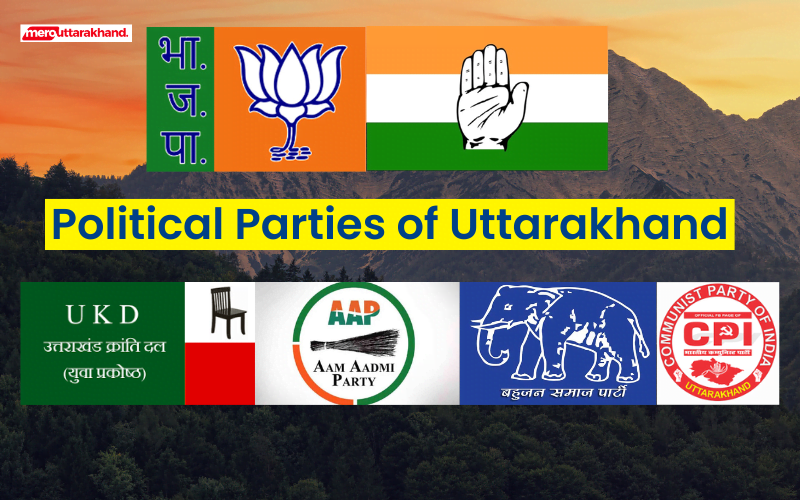
Overview
Uttarakhand, formed in the year 2000, has a multi-party democratic system. Over the years, several national and regional political parties have played important roles in shaping the state’s governance, development policies, and political culture. However, politics in Uttarakhand is mainly dominated by national parties, with limited influence of regional parties.
Major Political Parties in Uttarakhand
1. Bharatiya Janata Party (BJP)
The Bharatiya Janata Party (BJP) is one of the most influential political parties in Uttarakhand. It has formed the government multiple times and enjoys strong support, especially in urban areas and hill regions.
Key Leaders: Pushkar Singh Dhami (Chief Minister), Mahendra Bhatt (State President).
Current Status: Ruling Party.
Key Highlights:
- Ideology: Nationalism, development, cultural heritage
- Strong focus on infrastructure, tourism, Char Dham Yatra, and border development
- Currently one of the most dominant parties in the state
2. Indian National Congress (INC)
The Indian National Congress (Congress) has been a major political force in Uttarakhand since its formation. It has governed the state several times and has a strong base in rural areas.
Key Highlights:
- Ideology: Social democracy, secularism
- Focus on social welfare, employment, and rural development
- Main opposition party in the state
3. Uttarakhand Kranti Dal (UKD)
The Uttarakhand Kranti Dal (UKD) is a regional party that played a crucial role in the Uttarakhand statehood movement. Although its electoral presence has diminished, it continues to champion the “Hill Identity” and demands for a permanent capital at Gairsain.
Key Highlights:
- Ideology: Regional identity and state rights
- Historically important but currently has limited electoral influence
- Represents local and hill-centric issues
4. Bahujan Samaj Party (BSP)
The Bahujan Samaj Party (BSP) has a presence mainly in the plain districts of Uttarakhand, such as Haridwar and Udham Singh Nagar.
Key Highlights:
- Ideology: Social justice and empowerment of Dalits
- Influence limited but important in certain constituencies
- Plays a role in close electoral contests
- You also like this Uttarakhand State Symbols: Animal, Bird, Flower, Tree
5. Aam Aadmi Party (AAP)
The Aam Aadmi Party (AAP) is a relatively new entrant in Uttarakhand politics. It has been trying to expand its base by focusing on education, healthcare, and governance reforms.
Key Highlights:
- Ideology: Anti-corruption, good governance
- Growing popularity among youth and first-time voters
- Yet to gain major electoral success in the state
6. Communist Parties (CPI & CPI-M)
Left-wing parties like CPI and CPI(M) have minimal presence in Uttarakhand.
Key Highlights:
- Ideology: Socialism and workers’ rights
- Limited support base
- Occasionally active in labor and farmer movements
Uttarakhand’s political landscape is primarily a bipolar contest between the Bharatiya Janata Party (BJP) and the Indian National Congress (INC). Since its formation in 2000, the state has traditionally seen these two giants trade power every five years—a trend that was notably broken in 2022 when the BJP retained power for a second consecutive term.
As of early 2026, the state is under the leadership of the BJP, with the next major legislative assembly elections scheduled for February 2027.
Current Assembly Composition (5th Vidhan Sabha)
The Uttarakhand Legislative Assembly consists of 70 seats. A party needs 36 seats to form a majority.
| Political Party | Number of Seats (Approx.) | Status |
| Bharatiya Janata Party (BJP) | 47 | Government |
| Indian National Congress (INC) | 20 | Opposition |
| Bahujan Samaj Party (BSP) | 1 | Others |
| Independents/Others | 2 | Others |
Key Political Features of Uttarakhand
- The Two Capitals: Politics often revolves around the winter capital, Dehradun, and the summer capital, Gairsain (Bhararisain). The demand for Gairsain as the permanent capital is a recurring emotional and political issue.
- The “Changing CM” Trend: Uttarakhand has historically seen frequent changes in Chief Ministers within a single term. However, the current CM, Pushkar Singh Dhami, has provided relative stability since his reappointment in 2022.
- Hill vs. Plain Divide: Political strategies differ vastly between the “Pahadi” (Hill) constituencies, which deal with migration and lack of healthcare, and the “Maidani” (Plain) constituencies, which focus on industry and agriculture.
FAQs: Political Parties in Uttarakhand
Q1. Which party is currently dominant in Uttarakhand?
The Bharatiya Janata Party (BJP) is currently the most dominant political party in Uttarakhand.
Q2. How many major political parties are active in Uttarakhand?
There are two major national parties (BJP and Congress) and several smaller national and regional parties active in the state.
Q3. Is there any strong regional party in Uttarakhand?
The Uttarakhand Kranti Dal (UKD) is the main regional party, but its influence has declined over time.
Q4. When is the next assembly election in Uttarakhand?
The next Uttarakhand Legislative Assembly elections are expected to be held in February 2027.
Q5. What are the main issues in Uttarakhand politics today?
Major issues include:
Palayan (Migration): The emptying of hill villages as people move to plains for jobs.
UCC (Uniform Civil Code): Uttarakhand was the first Indian state to pass a UCC Bill.
Environment vs. Development: Balancing infrastructure projects with the fragile ecology of the Himalayas.

Kajal - Content Editor
Welcome to our blog! As the editor, my mission is to provide you with thoughtful, well-researched, and engaging content that educates, inspires, and provides value to your path. Each article is lovingly crafted to provide authenticity, clarity, and relevance, tackling a diverse array of topics that pique interest and provoke meaningful conversation. Our vision is to establish a platform where knowledge is exchanged, ideas thrive, and readers discover content that resonates.". Your suggestions and comments are always welcome—let's continue learning and growing together!


