Rishikesh-Karnaprayag Rail Line: Complete Overview
Kajal, 2 days ago, 3 min read, 28 Views
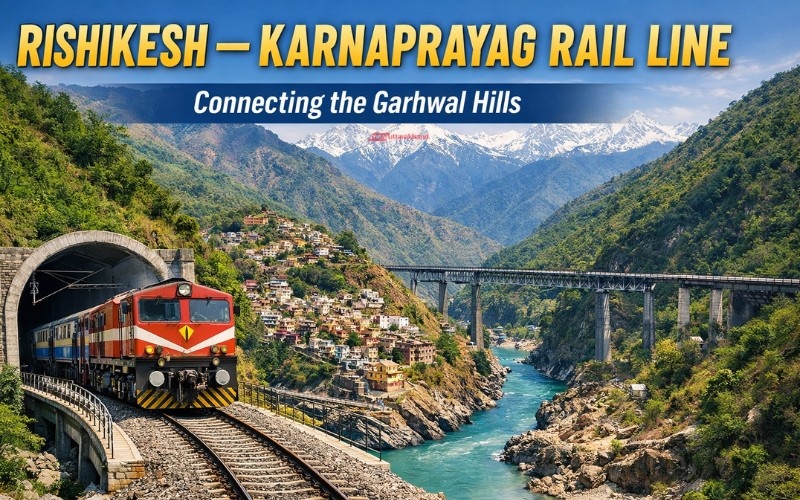
The Rishikesh–Karnaprayag rail line is one of the most ambitious railway infrastructure projects in northern India. Planned as a 125–126 km long broad-gauge single track railway, it will connect Yog Nagari Rishikesh in Uttarakhand’s plains to the hill town of Karnaprayag, enhancing accessibility to the Garhwal region and playing a key role in facilitating pilgrimage tourism and economic development.
Why This Project Matters?
Strategic Importance
This rail line is not just a regional link — it is a feeder route to the larger Char Dham Railway network, which aims to connect the four major Hindu pilgrimage sites — Yamunotri, Gangotri, Kedarnath, and Badrinath. It forms the backbone of Indian Railways’ plan to make travel in the Himalayan region faster, safer, and all-weather capable.
Connectivity and Travel Time
Currently, road travel from Rishikesh to Karnaprayag can take 6–8 hours or more depending on traffic and weather conditions. Once complete, the railway will reduce this to around 2–3 hours.
Geostrategic Value
The route also enhances connectivity close to sensitive mountainous borders and supports troop and logistics movement, reinforcing infrastructure in important defense zones.
Project Details and Features
Length and Route
Total Length: Approximately 125 – 126 km.
Type: Broad gauge (single track), electrified railway.
Operator: Indian Railways through Rail Vikas Nigam Limited (RVNL).
Terrain: Mountainous Himalayan region – very challenging geology.
Stations on the Line
There will be 12 railway stations between Rishikesh and Karnaprayag which serve both passengers and regional connectivity:
Yog Nagari Rishikesh – Starting point.
Muni Ki Reti – Gateway to Badrinath route.
Shivpuri
Manjilgaon
Sakni
Devprayag – Confluence of Alaknanda and Bhagirathi.
Kirtinagar
Srinagar
Dungripanth (Dhari Devi)
Dhari
Gholtir
Karnaprayag – End point.
These stations traverse parts of five districts — Dehradun, Tehri Garhwal, Pauri Garhwal, Rudraprayag, and Chamoli — connecting major towns and tourist spots.
Engineering Challenges
Building a railway through the Himalayan foothills and high mountains involves extreme engineering complexity:
17 major tunnels with a combined length exceeding 100 km, meaning about 80–85 percent of the alignment runs underground.
One of the tunnels (Tunnel No. 8 between Devprayag and Janasu) is around 14.57 km long, making it one of India’s longest rail tunnels.
More than 35 bridges are being constructed over rivers and valleys to manage terrain elevation changes.
Work uses advanced techniques like Tunnel Boring Machine (TBM) and New Austrian Tunneling Method (NATM) due to difficult geology.
The project also installs escape tunnels alongside main tunnels for emergency evacuation.
Read More About – Famous Institutions in Uttarakhand
Timeline and Development Status
Historical Progress
Alignment and survey work began more than a decade ago, with detailed feasibility in 2015.
Construction work began in stages from 2018–2019 onwards.
Current Status (as of 2026)
Over 70 percent of physical work is completed.
Tunneling work is nearing completion with most major tunnels completed or close to breakthrough.
Track laying and station construction are underway.
Completion Outlook
Originally slated for 2026 completion, current realistic estimates suggest the full project may be completed by December 2028 due to complexities in tunneling and construction pace.
Benefits of the Project
Faster and Safer Travel
The railway will significantly cut travel time and provide a year-round all-weather transport option, especially valuable during monsoons and winter when roads can get blocked.
Boost to Tourism and Pilgrimage
Devprayag, Karnaprayag, and other pilgrimage sites will become more accessible, boosting tourism and local economies.
Economic and Social Impact
Better connectivity enhances trade, job creation, and access to services for remote hill communities.
Strategic Connectivity
The line also enhances logistical support and infrastructure development in the sensitive Himalayan belt, important for national security planning.
Challenges and Concerns
Building railways in fragile mountain ecology presents challenges:
Complex geology demands careful engineering.
Environmental sensitivity and stability issues need constant monitoring.
Delays due to terrain, weather, and technical difficulties have pushed timelines beyond original targets.
Frequently Asked Questions (FAQs)
Is the Rishikesh–Karnaprayag rail line operational now?
No. It is still under construction and scheduled for full completion around 2028.
How long will the railway be?
About 125–126 km from Yog Nagari Rishikesh to Karnaprayag.
How many stations will it have?
A total of 12 stations are planned along the route.
How much will travel time reduce?
Road travel 6–8 hours. Railway approximately 2–3 hours (approx.).
What’s unique about this project?
Around 105 km of tunnels through Himalayan rocks; many of the longest rail tunnels in India.

Kajal - Content Editor
Welcome to our blog! As the editor, my mission is to provide you with thoughtful, well-researched, and engaging content that educates, inspires, and provides value to your path. Each article is lovingly crafted to provide authenticity, clarity, and relevance, tackling a diverse array of topics that pique interest and provoke meaningful conversation. Our vision is to establish a platform where knowledge is exchanged, ideas thrive, and readers discover content that resonates.". Your suggestions and comments are always welcome—let's continue learning and growing together!


